This page contains information on response procedures for safety-related incidents. Below you find specific information on spills, chemical exposure, contact information of medical facilities, etc.
Procedures for Incident Response
Contact Information of Nearby Medical Facilities
For incidents related to UW Madison research activity, your insurance or the university will cover the cost of medical treatment. Thus, do not hesitate to go to the hospital!
In Case of Emergency (call 911 if you need assistance with getting to the hospital)
University Hospital (everyone can go there)
- 600 Highland Ave.
- 608-263-6400
Non-Emergency
University Health Services (for students)
- UHS Clinic, 333 East Campus Mall
- (608) 265-5600, Option 1
Occupational Medicine (for employees)
- UHS Clinic, 333 East Campus Mall
- 608-265-5610
University Hospital (for students and staff)
- 600 Highland Ave.
- 608-263-6400
Chemical or Biological Spills
Who should you contact?
In an emergency, call 911!
For non-emergency, call your PI and/or Chemical Safety (608-265-5700) or Biological Safety (608-263-2037) if you have questions about how to clean up a non-emergency spill.
What should you do?
Follow the instructions outlined in the guidelines for handling chemical and biological spills.
Chemical or Biological Exposure
Who should you contact?
In an emergency, call 911!
For non-emergency, call your PI and/or Chemical Safety (608-265-5700) or Biological Safety (608-263-2037).
What should you do?
Splashes
If something splashes on your skin or gets into your eye, use the safety shower or eyewash for at least 15 minutes. If you feel like you do not need immediate medical attention but would like to get evaluated, contact UHS (for students) or Occupational Medicine (for employees). If you are experiencing symptoms or otherwise would like to be evaluated immediately, go to the emergency room at the University Hospital (see address above).
Needle Sticks or Cuts
If the wound is not deep, wash the wound with soap and water and apply a bandage. If the wound is more severe and you feel like you need medical attention, go to the emergency room immediately. If you feel like you do not need immediate medical attention but would like to get evaluated, contact UHS or Occupational Medicine.
Other Lab-Related Injuries
Who should you contact?
In an emergency, call 911!
For non-emergency, call your PI and/or Chemical Safety (608-265-5700) or Biological Safety (608-263-2037).
What should you do?
If you would like to get medically evaluated, schedule an appointment with UHS or Occupational Medicine for non-emergencies. For emergencies, go to the emergency room at the University Hospital.
If your injury requires treatment beyond first aid, report to your PI to fill out an Injury and Illnesses Report.
Fire
Who should you contact?
Follow the instructions below point by point – they will include information on who to contact how.
What should you do?
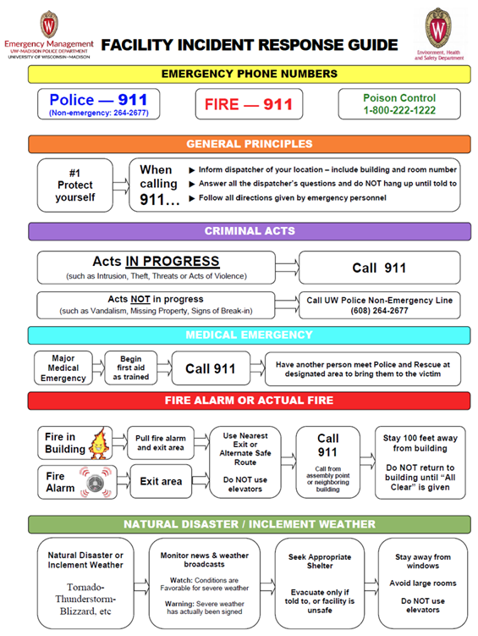
If the fire alarm goes off in the building, immediately leave the building. Try to quickly turn off any gas lines or open flames before leaving the lab. Do not stop to grab your belongings. Go to your group’s meeting spot outside of Engineering Hall.
If there is a fire, only attempt to extinguish it if you are trained to use a fire extinguisher and you feel comfortable doing so. If the fire is too big or aggressive, or you do not feel comfortable with attempting to extinguish it, pull the fire alarm, exit the building, and when in safety immediately call 911. Provide information on how you can be reached by the first responders!
Hydrogen Distribution System Alarms
Examples include red flashing alarms, yellow flashing alarms, error messages etc.
Who should you contact?
Follow the instructions below point by point – they will include information on who to contact how.
What should you do?
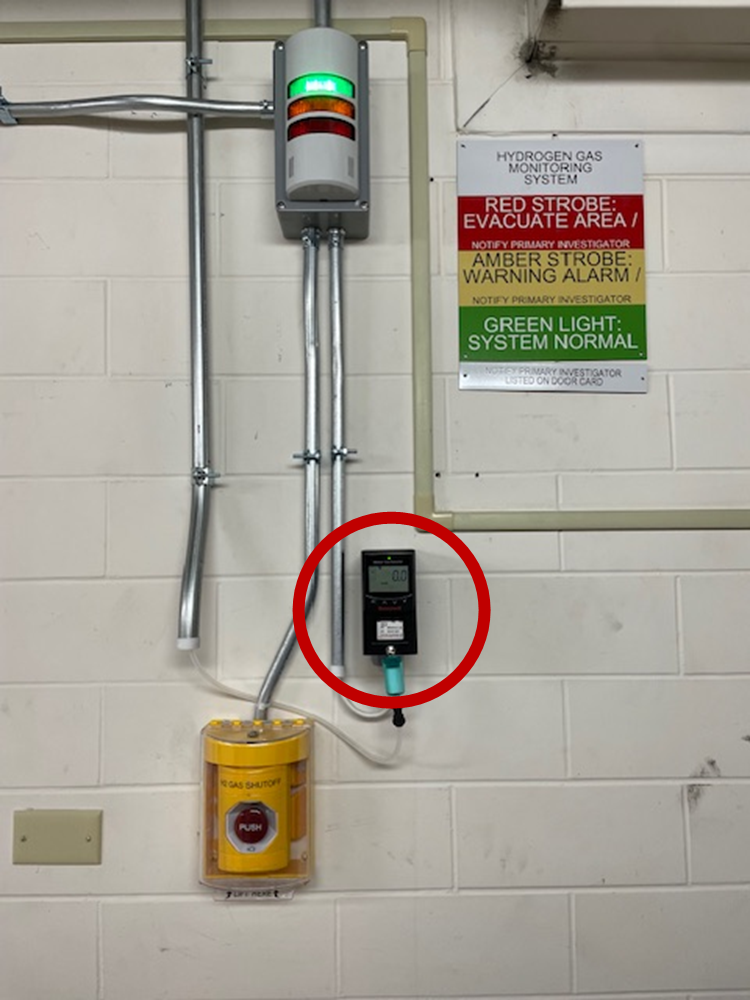
- If you see a yellow alarm with 0% LEL gas detected on the Honeywell detectors (circled in photograph below) both by the alarm and on the surrounding detectors, then contact Prof. Krishna, Matt Edgar, or Brandon Tipton. This could be a communication fault.
- If you see a yellow alarm with >10% LEL gas detected on the Honeywell detectors (circled in photograph below), then a leak is likely occurring. Hit the red shutoff button below the alarm (this will close the valves supplying gas in that area) and evacuate the area then contact Prof. Krishna or Chris Crawford. Chris Crawford is the building manager who is familiar with the system. His phone number is 6082652549.
- If you see a red alarm, then the valves have already been closed automatically by the system. Alert the people you are working with and evacuate the area immediately. Once in a safe area (outside) contact Prof. Krishna or Chris Crawford.
Utilities Failure
Examples include power outage, flooding, leaks, etc.
Who should you contact?
If not an emergency and during business hours, contact your PI.
Outside of business hours, if it is an emergency, or if your PI cannot be reached, call University of Wisconsin-Madison Facilities (Physical Plant) at (608) 263-3333 or UW Madison campus police at (608) 264-2677. If the situation is posing a danger, call 911.
What should you do?
If the situation is dangerous, leave the area. Provide information on where the issue is occurring and how you can be reached once technicians arrive on location.